

In manufacturing, production efficiency depends as much on how documents and approvals move as on how machines perform. Delays often happen in the administrative and process layers: waiting for change order sign-offs, referencing outdated work instructions, or chasing compliance records. By automating document workflows, manufacturers can eliminate these bottlenecks, maintain consistent quality, accelerate production cycles, and ensure audit-ready compliance.
Why Document Workflow Automation is Critical for Manufacturing Efficiency
Operational friction often stems from manual handling of critical documents. Approvals, Standard Operating Procedures (SOPs), inspection reports, and quality checklists move slowly when they rely on physical signatures, emails, or siloed storage. Automating the workflow ensures that every document flows to the right person at the right time, eliminating delays, reducing errors, and improving overall production throughput.
Zero-Delay Approvals and Smart Routing
In manufacturing, delays in approvals can directly halt production. Smart routing automates these approval processes according to embedded business rules, ensuring that critical documents like Quality Check (QC) reports, change orders, or work instructions reach the right people immediately. For example, a QC report from the shop floor can be sent automatically to engineers, supervisors, and quality managers in the correct sequence. Automated alerts prompt sign-offs even across shifts or remote sites, meaning that production lines continue moving without waiting for manual approvals, reducing downtime and minimizing costly bottlenecks.
Version Control in Manufacturing Operations
Manufacturing errors often occur when outdated work instructions or drawings are used. Centralized version control ensures that all teams access only the latest approved documents. Previous versions are automatically archived, preventing mistakes and eliminating confusion, which translates into reduced rework and scrap rates.
Integrated Compliance in manufacturing operations
For regulated industries, audit readiness is critical. Document workflow automation creates immutable audit trails, recording who accessed, edited, or approved each document. Compliance with standards like ISO 9001 (International Organization for Standardization), FDA (U.S. Food and Drug Administration), or GxP (Good Practices for manufacturing and quality) becomes a natural part of daily operations. Platforms like MaxFiles make this effortless, allowing teams to respond to audits in minutes instead of days while keeping production uninterrupted.
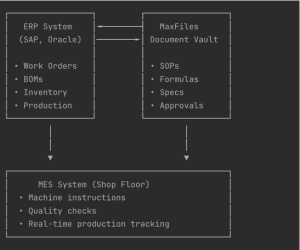
Seamless Integration with ERP and MES Systems
Maximizing efficiency requires linking document workflows to operational software. Integration enables:
- Automatic population of templates with ERP (Enterprise Resource Planning) data, such as work orders or material specifications
- Real-time status updates pushed to MES (Manufacturing Execution System) after document approvals
- Elimination of manual data entry and transcription errors
This ensures that document management actively accelerates production rather than creating friction.
Tracking Operational Metrics and ROI
Automation isn’t just about convenience — it delivers measurable outcomes:
- Reduced production cycle times through faster approvals
- Lower compliance labor costs by automating audit-ready reporting
- Fewer errors and rework due to version-controlled, centralized documents
By monitoring these metrics, manufacturing leaders can quantify the value of intelligent document workflows and make informed decisions about scaling automation.
Turning Documentation into a Competitive Edge
In manufacturing, efficiency is ensuring the right information is in the right hands at the right time. Automated and centralized document workflows eliminate bottlenecks, reduce errors, and embed compliance into daily operations. They also safeguard institutional knowledge, ensuring continuity despite staff changes. When documentation becomes a controlled, reliable asset rather than a manual chore, it transforms into a competitive advantage, helping manufacturers deliver, scale and maintain operational excellence. Tools like MaxFiles make this transition seamless, giving teams the confidence to focus on production and growth.
Frequently Asked Questions (FAQ)
Is a cloud-based DMS secure for proprietary manufacturing documents?
Yes. Enterprise-grade platforms like MaxFiles provide encryption, strict access controls, and redundant storage, often exceeding traditional on-premise security. DMS stands for Document Management System.
Will DMS integration disrupt ongoing production?
No. Implementations are staged and API-driven, integrating with ERP and MES systems without halting production. Workflow deployment can be piloted department by department.
How does document workflow automation support training and knowledge transfer?
Current SOPs, certifications, and training materials are stored centrally. Operators’ access can be linked directly to qualifications, ensuring only trained personnel execute critical tasks.
Can workflow automation be introduced gradually?
Yes. Start with high-priority documents or critical processes, then scale across the organization. Adoption is smooth as teams see immediate efficiency gains.
How does automation improve audit readiness?
Every action on a document is logged, creating a transparent and immutable trail. Compliance becomes a byproduct of production rather than an additional task.
How quickly can teams adapt to a new DMS like MaxFiles?
MaxFiles is intuitive, similar to familiar tools like messaging apps. Short training sessions combined with hands-on use allow teams to adopt workflows quickly, minimizing disruption.